
Osaka in Peak Season vs. Off-Season: How Your Group Reacts, and How to Plan Dates Around a Street Kart Tour
Osaka in Peak Season vs. Off-Season: How Your Group Reacts, and How to Plan Dates Around a Street Kart Tour
"So... when are we actually going?"
Someone drops that line into a six-person group chat. It gets read. Everyone reads it. Nobody replies. Three days go by.
If you've ever planned a trip to Osaka, this probably sounds familiar. Group trips rarely fall apart over where to go. They fall apart over when. And even in the same Osaka, your friends act very differently depending on whether you go in peak season or off-season.
This article uses your travel companions' reactions as a guide for planning a group trip to Osaka. At the center of the plan is a guided street kart tour. Lock that in first, and everything else starts to fall into place.
Why does the group's mood change with the season, even in the same Osaka?
In Japan, people tend to take their holidays at the same time. Visitors from countries where everyone schedules their own time off often find this new.
Golden Week (a long run of spring holidays). Obon (the summer season when people go back to their hometowns). The New Year holidays. During these periods, domestic travelers all move at the same time. In Dotonbori and Shinsaibashi, you'll notice the crowds get much thicker as you walk.
The crowds themselves aren't really the issue, though. What matters is that people react to crowds in very different ways.
Some people get more excited the bigger the crowd gets. Others go quiet after 30 minutes of walking. When you travel alone, you can just slip away at your own pace. In a group, the most tired person sets the pace for everyone.
So what about the quieter weeks outside the big holidays, mostly on weekdays? On the same streets, people walk at a different speed. When you stop to take a photo in front of the Glico sign, you spend less time worrying about the people behind you. Small as that sounds, it changes how much your group talks to each other.
So before you pick dates, ask yourself one question: "How will this group handle crowds?" Answering that once makes every decision after it much easier.
Osaka in peak season: what tends to happen to a group of six
Picture six people: two from the US, two from Germany, two from Singapore. They arrive in Osaka right in the middle of a major holiday.
On day one, everyone is full of energy. The buzz as you walk out of Namba Station. The huge signs lined up along the Dotonbori canal. The smell of sauce caramelizing on a grill somewhere nearby. "This is Osaka!" Six phones go up at once. It's a great moment.
The mood usually starts to change around day two. While you're waiting in line at a takoyaki stand, one of the Germans mutters, "We could have tried another place in the time we've spent in this line." The Singaporeans are used to crowds and don't mind. In peak season, small gaps in how people feel like this slowly add up.
Here's the truth: in peak season, crowds aren't your biggest problem. Six people deciding "what's next?" on the spot is. Stopping in the middle of a crowd to talk it over drains everyone's energy. Once someone says "I don't care, anywhere's fine," that's your warning sign.
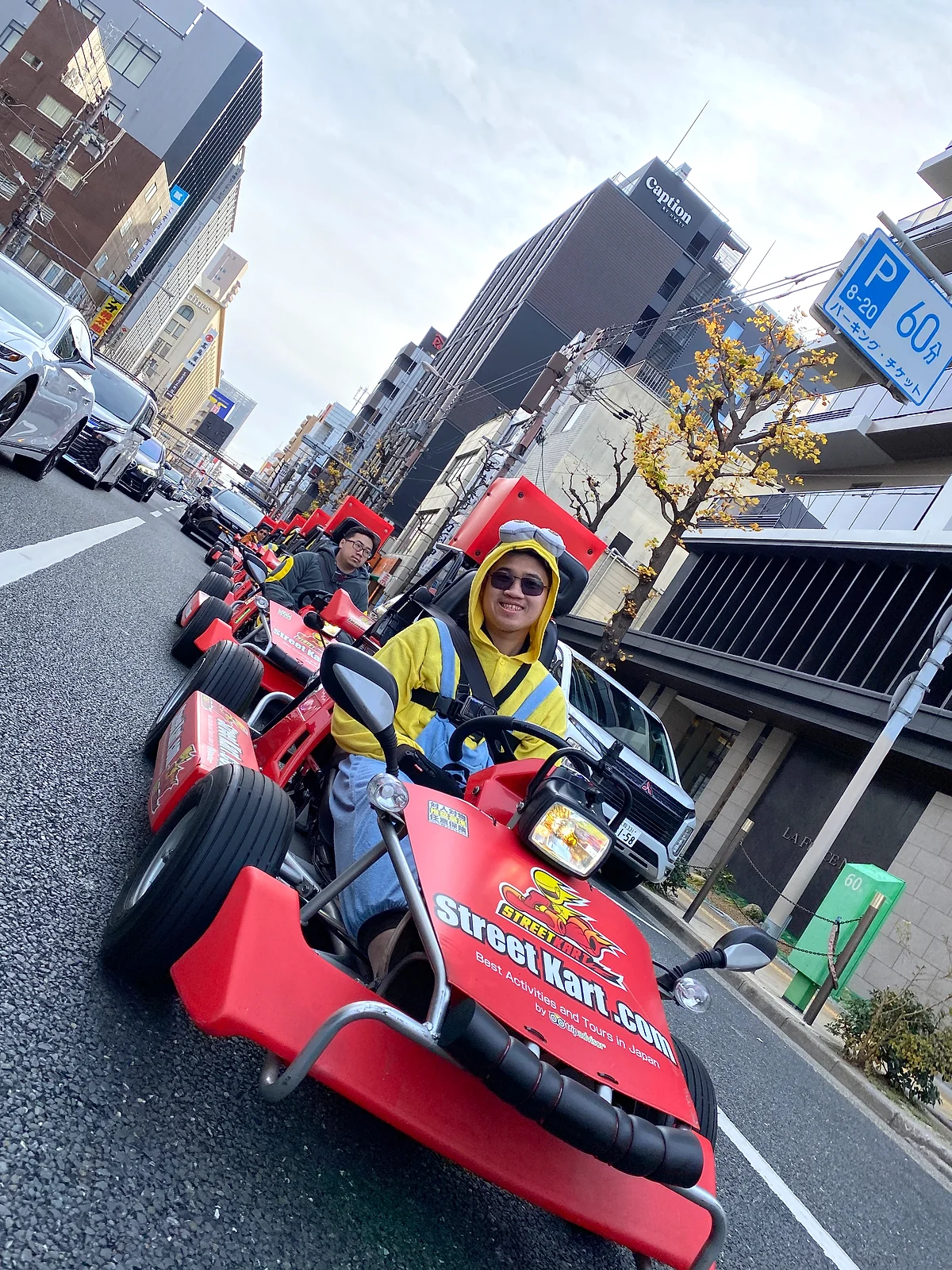
This is where it helps to put one plan in your itinerary that already has a fixed time and place. A street kart tour is exactly that. You meet at the Osaka store in Minamihorie at your booked time slot. After that, you just follow the guide along a set course. Nobody has to choose a route. For that stretch of time, at least, everyone gets a break from "where should we go next?"
The course also runs through Amerikamura, Shinsaibashi, Dotonbori, and Namba, the very areas where walkers tend to get swallowed by the crowd. Places where you couldn't stop on foot, you now drive through behind your guide. You see the same city from a different height and at a different speed. I suspect this is where the crowd-weary members of your group start to perk up again.
There's one more thing to watch out for on travel days in peak season: luggage. On the day you check out of your hotel and then head to the tour, what do you do with six people's suitcases? The store has lockers, but they're for small items and won't fit large luggage like suitcases. You can only bring a fairly small bag on the kart. So check ahead of time whether your hotel's front desk can hold your big bags, then head to Minamihorie with only light bags. Settle this the night before, and that's one less "so what do we do with our bags?" on the morning of the tour. The store also has no parking, so if your group is getting around by rental car, plan to take the train on that day.
Osaka in the off-season: why the same group seems like different people
So what if the same six people came on weekdays outside the big holidays?
Sometimes it feels like the group has a whole different personality. Seriously.
First, it gets easier to split up. In peak season, people worry about losing each other and not being able to meet back up, so everyone tends to stick together. In the off-season, "Let's meet near Nishi-Ohashi Station in two hours" is a much easier sell.
The two shoppers head to Daimaru Shinsaibashi. The street-food fans take the train to Kuromon Market. The vintage lovers wander around Triangle Park in Amerikamura. Each person collects their own piece of Osaka, and then everyone shares stories over dinner. For me, that's the best part of an off-season group trip.
People react a little differently to the street kart tour, too. In peak season, they enjoy it as an escape from the crowds. In the off-season, they have more room to take in the city itself. The streets of Minamihorie lined with shops and cafés, the neighborhoods around Yotsubashi: those things start to catch their eye. After the tour, someone might say, "Want to walk down that street we just drove through?"
The off-season has its own trap, though: thinking "It's quiet, so any time will work." That's how people end up putting off pinning down everyone's schedule. Which departure slots are open depends on the time of year. If you have a date in mind, contact the store through the official website early to check.
Lining up everyone's schedule: make the kart tour your "anchor"
Now for the main point.
When a big group of friends is coming, build the itinerary from the plans you can't move. That's the easiest way to do it. Something like a street kart tour, which needs a reservation and needs everyone in the same place at the same time, works like a ship's anchor. Drop it first. Flexible plans like meals and shopping can then be arranged around it.
Here's the order:
First, list the days when everyone in the group will be in Osaka. Flight arrival times always differ from person to person. You'll probably find fewer "everyone's here" days than you expected.
Next, narrow those down to two or three possible days for the kart tour. Don't pick just one day. If you can't get that booking, the whole plan falls apart.
When you choose your dates, think about the weather along with the crowds. In light to moderate rain, tours run as scheduled and free raincoats are provided. In heavy rain or a typhoon, the tour is canceled, and you choose between a shortened tour (with the difference refunded), moving to another day, or a full refund. If you're planning during the rainy season or typhoon season, put the kart tour early in your trip and keep a flexible day open later on. That way, if you do have to move to another day, you won't end up with a new date after some of your group has already flown home.
What to wear also depends on the season. The basic rule is closed-toe sneakers. Avoid sandals, heels, skirts, and dresses. In summer, bring a hat, sunglasses, and sunscreen. In colder months, bring a jacket suited to the season. If someone in your group has been wearing sandals the whole trip, drop a quick "Sneakers tomorrow, okay?" in the chat the night before.
Let's talk about group size too. The standard group is up to six drivers and one guide. How groups larger than six are handled varies by store, so check the official website (kart.st) beforehand. Reservations are accepted through Facebook, LINE, and email, so find the contact details on the official website.
If you're aiming for a weekend, book first
Weekend slots fill up fast. Keep that in mind.
Do some of your friends only have weekends free because of work? Then contact the store to book on the same day you settle the dates. Move that fast.
There's a classic group-trip mistake: "Let's wait until everyone replies before we book." While you're waiting, the slots fill up.
So the organizer needs to set a deadline. "I'd like to lock in this date. If I don't hear back by X, I'll go ahead with it." In Japanese, that's shimekiri, a deadline. A bit businesslike? That's fine. Just having one cuts down a lot on people reading the group chat and never replying.
If you're booking early, share the cancellation policy in the chat too. Cancellations are said to be free up to seven days before the tour. "Let's book now and reconfirm the headcount seven days out." Agree on that, and the organizer's deadline has a clear reason behind it. Policies can change, so check the latest terms on the official website when you book.
If most of your group can travel on weekdays, making a weekday your first choice is another good option. If someone in the group doesn't like crowds, it's a considerate choice for them too.
Licenses and documents come down to "the last person"
One thing people often overlook is the requirements for driving.
Even if five out of six are ready, if one person isn't, that person may not be able to join. The license and document requirements depend on your nationality and the type of license you have. For details, check the official website.
One tip: the organizer shouldn't try to look up everyone's requirements.
The requirements are different for each person. It's more reliable to post the link in the group chat and say, "Check this yourself, and send a sticker when you're ready." If the stickers stop at five, message the last person directly. It's not exciting. But do it a few weeks before the trip and you won't be scrambling on the morning of the tour.
Check one more time on the morning of the tour. You need your original physical license; digital licenses are not accepted. If you don't have the required documents on the day, you can't take part and you won't get a refund. If one person drops out because "I left it in the hotel safe," the whole group's mood sinks. Before heading out, have everyone hold up their licenses for each other in the hotel lobby. Being that careful is about right. As for meeting time, arriving 15 minutes early is required because of check-in and the safety briefing. If someone in your group tends to run late, give them an earlier time.
A note on language: on the day of the tour, guidance is mainly in English. Guidance in Japanese or other languages depends on which staff are working that day, so it can't be guaranteed. If you have concerns, contact the store through the official website in advance. The website itself is available in 22 languages.
Before and after the tour, explore on foot from Minamihorie
The Osaka store is in Minamihorie, about a 3-minute walk from Nishi-Ohashi Station and about 5 minutes from Yotsubashi Station. It's a neighborhood full of stylish shops and cafés.
On a group trip, it's rare for everyone to show up on time. Here, whoever arrives early can wait at a nearby café. That makes the organizer's job a lot less stressful.
After the tour, planning your moves by area makes it easier to match everyone's tastes. To be clear, these spots are not part of the course. They're places you can visit on your own before or after the tour.
Amerikamura is about a 5-minute walk from the store. It's an area packed with vintage shops and streetwear stores. You walk the streets you just drove through, this time on foot. "Where was that shop we saw earlier?" Going off to look for it is fun in any season.
Chibo, an okonomiyaki restaurant, is about a 10-minute walk away. With a big group, picking a restaurant always turns into a debate. Decide where you'll eat after the tour ahead of time, and have a backup in mind in case it's packed. If some of your group prefer a calmer atmosphere, walk about 20 minutes to Hozenji Yokocho. It's a small alley of kappo and traditional Japanese restaurants, and it shows you a side of Osaka quite different from the noise of Dotonbori.
For shoppers, Daimaru Shinsaibashi and the Shinsaibashi-suji shopping arcade are about a 15-minute walk. If you want to go farther, consider Kuromon Market (about 10 minutes by train), Abeno Harukas (about 15 minutes), and Osaka Castle (about 20 minutes). In the off-season, it's also easier to split into two or three smaller groups here and meet up again in the evening.
Finally, one Japanese phrase: Osaki ni shitsurei shimasu. It's a polite way of saying "I'm heading out first." You say it to your friends, or anyone else you're with, when you leave before them. It's handy for anyone splitting off to go back to the hotel early. Worth remembering.
Choosing when to go means picturing the people you're going with
Osaka in peak season has the energy of a festival. Osaka in the off-season gives you time to take in every side street.
Which is the right choice? The people you're traveling with decide that. If most of your friends get excited in a crowd, dive into the peak-season energy. If most of them like to take things slow, aim for weekdays outside the big holidays.
Either way, the plan is the same:
List the days when everyone is there. Make the street kart tour your anchor. Pick several possible dates. Contact the store to book early.
Start by checking the tour details and booking contacts on the official website. Then post some possible dates in your group chat.
"So... when are we actually going?"
This time, you're the one with the answer.
This article was originally written in Japanese and translated using AI. Some expressions may read unnaturally, and we appreciate your understanding. For the most accurate and up-to-date information, please refer to the official site at kart.st.
Street Kart is not affiliated with Nintendo or the Mario Kart series in any way. We do not provide costumes of Nintendo characters, and such costumes may not be worn during tours even if brought by participants.